

The
book contains over 70 simple pictures, that enable you to instantly
recognise the shape and sound of each thai symbol.
If
you are able to memorise the following, you can memorise the
thai alphabet:
= 
Chariot Traveller
(a detailed sample of the book is found further down this page)
Thousands
of copies have sold since its launch in 2005
And the book has received very positive reviews on many leading
sites including:
ThaiVisa.com,
ZDNet.com, WomenLearnThai.com and Entrepreneur.com etc
(testimonials
are listed below)
100% Money
Back Guarantee
The Book can be downloaded
Instantly
PayPal & Credit
Cards Accepted
Now Reduced from $49.99 to $19.99:
- fully
updated version of the book, in a digital flip book style
- pdf
version of the book
- mobipocket
version of the book, for your pocket pc and smartphone!
Works on Mac, PC, Ipad, Iphone and Windows Mobile
Payment processing:
Our payments are
processed through Clickbank.com. The clickbank return policy
is as follows:
ClickBank will, at its option, replace or repair
any defective product within 60 days from the date of purchase.
After 60 days all sales are final. ClickBank does reserve the
right to alter or revise its return policy at any time.
Testimonials:
Entrepreneur.com:
"After only an hour of reading, the Thai alphabet
will begin to make sense - you'll be able to identify
the shape, sounds and class of the entire Thai alphabet.
The memory system relies on simple images, that enable
you to instantly visualize and remember the Thai symbols.
Even the youngest of readers will be able to use the system,
and have a good grasp of the alphabet in as little as
1 hour." |

 |
ThaiVisa.com:
"If you are a total beginner and struggling,(this
is)... one easy way to get an introduction...not expensive" |

 |
WomenLearnThai.com
"And if you’ve started to panic at the thought
of learning 44 Thai consonants (along with their initial
and final sounds), 32 different vowel configurations,
numbers, and all those extra symbols, then head over to
the previously mentioned digital flipbook" |

 |
Sample
from the book:
The book is based on a core principle of memorization:
find connections between the new information, and what you already
know. In this book, we have created pictures that will enable
you to almost instantly remember the shape and sound of the
Thai letters with little effort.
Like scaffolding on a building, the system acts
as a temporary support, to permit your mind to build a memory
of the letters. But over time, you will automatically picture
the letter, and hear the sound, without needing the stepping
stone or scaffold, afforded by these images.
They enable you to surmount the primary obstacle
in learning the letters - which is relating to the abstract
shapes, and associating these shapes with their respective sound.
About the Thai Alphabet
There are 44 consonants in the Thai alphabet,
and 32 vowels. However, some of these vowels are just long and
short versions of each other, so it is actually only necessary
to learn around 20 different vowel shapes. Thie may sound daunting
- but carry on reading. We assure you that even the most casual
of tourists will be easily able to learn these characters effortlessly.
The Thai Tones
Thai words are broken up into syllables, and each
syllable has a distinct tone.
The five tones in Thai are as follows:
1. Low (said in the lower part of your voice's
register)
2. Middle (said in the middle part of your register)
3. High (said in the higher part - as if you are calling someone
at a distance)
4. Falling (like the word no , when saying oh no if you are
disappointed)
5. Rising (like the tone used, when asking someone if they are
coming along: coming? )
How consonants affect the syllable's Tone?
Thai consonants are broken into 3 groups known
as classes: called low, middle and high for convenience. These
names don't mean that the syllable will be low, middle or high
tone - the names of these groups might as well as be 1,2 and
3 - it's just a way of separating the consonants into three
groups.
The reason you need to know the class, is because
the class affects how the syllable is pronounced, so when you
learn the thai consonant, you will have to recall both its sound
and its class.
The rules for determining the tone of a syllable
are given in the Tones Section, at the end of the book, but
we'll give a quick example here, to give you an idea of why
you must learn the classes:
Example 1:
When a High Class consonant with the sound s , is followed by
a dead-sound (ie a sound that ends quickly), like at
or ad , then the tone of the syllable is Low.
Example 2:
When a High Class consonant with the sound s , is followed by
an open sound (a sound that lasts longer, like a long vowel
or a nasal sound like n or m that kind of hums on), then the
Tone of the syllable is a Rising Tone!
Seems complicated, but the technique will enable
you to remember these rules in seconds.
For now just
be aware that you'll need to remember the class as well as the
sounds of the thai letters - easy really, with the special technique
you'll learn about below.
Introduction to the consonants
For now, lets just concentrate on learning the
sound of each letter, and its class.
Certain Thai letters also have different sounds,
depending on whether the letter appears at the start or end
of the syllable.
So in summary, when you look at a Thai Letter,
you must be able to recall three things:
1. its sound when its at the start
of a syllable
2. its sound at the end of a syllable
3. its class.
The memory Technique
The memory technique which we'll use to learn
the alphabet, is best illustrated with an example.
Take a look at the thai letter below on the left,
and notice how it resembles the image to the right:
= 
Chariot Traveller
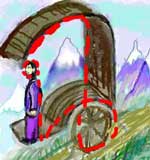
The similarity is high-lighted, by the dashed
red-line in the image.
The picture resembles a Chariot with a Traveller
onboard, driving through a High Mountainous Terrain.
This image encodes all the information that you need to recall,
when looking at this Thai letter.
1. Its sound is Ch (chariot), when at the start
of a syllable
2. Its sound is T (traveller), when at the end of a syllable
3. Its class is High, symbolised by the high mountainous terrain
in the background
Memorising the Classes
To help you memorise the classes, we represent
the three different classes, with different backgrounds:
1. High class consonants have a mountainous background
2. Middle class consonants have an urban background
3. Low class consoants have a sea level, sea-side background
- simple and logical!
How it works in Practice:
1. You look at the Thai letter and automatically
think of the image.
2. The easy-to-remember title will spring to mind and tell you
the sounds.
2. The image's background will tell you the class (low, middle,
high)
Easy and remarkably effective!
About Memorisation:
The key to memorisation is to get a foot-hold
on what you are trying to remember. The thai alphabet is something
you've never seen before, and is pretty alien, so the best way
to get your head around it, is to find things that it resembles,
and create connections with what you know.
This book has done that already for you, so you
have an automatic connection for every letter, shaving months
off the learning process.
Concentrating on the letters
Concentrate on how the letter resembles the image,
and how the image's title encodes the sounds of the thai letter.
Visualise the situation in your mind until you
clearly see the resemblances. Remember that the background will
encode the consonant's class.
There are some explanatory notes to the right
of each image, which should only be necessary the first time
you look at the image.
So the next time you see the Thai character, just
think of the image that the letter resembles. The title and
background will spring to mind without effort. Then you'll automatically
know the letter's sounds, and class!
How to approach the learning process
Visualise each image in your mind, and then move
on to the next one - don't sweat or worry about it.
Don't overly tax yourself, instead just spend
20 to 30 minutes looking at some images, and then take a break
for around 10 mintues. Come back and cover up the images, and
try to remember the image, title and background, from looking
at the thai letter.
Don't worry about not memorising it perfectly
first time off - just get an idea of things.
Revision
Move on, and try some new images, or take a break
until the next day.The key to remembering though, is to repeat
your exposure to the images often, until you remember them.
An example of a revision schedule would be something
like this:
Practice and revise the images 10 minutes after the first exposure.
And then, 1 day after the first session, a couple of days after,
a week after, a month after etc.
The images are like a scaffolding that will help
you to build your memory of the letters, and will fall away
after, as your mind automatically recognises the sounds and
class of the letters.

Low Class Consonants
The 24 Low Class Consonants are grouped together
in the following pages. In each of the images, there is a seaside
(low-level) background, to help you to recall that you are looking
at a low class consonant.
= 
Training
Somebody Training with a dumbell down at Venice
Beach!
So the sound is T.